
Women's health
7 Things You Think Are "Just Ageing" (That Are Actually Cortisol)
By Rachel Vance, Health Editor·Medically reviewed by Dr Naomi Reyes, OB-GYN·5 min read
FREE SHIPPING
90 DAY MONEY BACK GURANTEE!
FALL BUY ONE GET ONE FREE
FREE SHIPPING
90 DAY MONEY BACK GURANTEE!
FALL BUY ONE GET ONE FREE
FREE SHIPPING
90 DAY MONEY BACK GURANTEE!
FALL BUY ONE GET ONE FREE
FREE SHIPPING
90 DAY MONEY BACK GURANTEE!
FALL BUY ONE GET ONE FREE
FREE SHIPPING
90 DAY MONEY BACK GURANTEE!
FALL BUY ONE GET ONE FREE
FREE SHIPPING
90 DAY MONEY BACK GURANTEE!
FALL BUY ONE GET ONE FREE
FREE SHIPPING
90 DAY MONEY BACK GURANTEE!
FALL BUY ONE GET ONE FREE
FREE SHIPPING
90 DAY MONEY BACK GURANTEE!
FALL BUY ONE GET ONE FREE
FREE SHIPPING
90 DAY MONEY BACK GURANTEE!
FALL BUY ONE GET ONE FREE
FREE SHIPPING
90 DAY MONEY BACK GURANTEE!
FALL BUY ONE GET ONE FREE
FREE SHIPPING
90 DAY MONEY BACK GURANTEE!
FALL BUY ONE GET ONE FREE
FREE SHIPPING
90 DAY MONEY BACK GURANTEE!
FALL BUY ONE GET ONE FREE
If you're a woman over 40 and something has changed — your sleep, your middle, your energy, your patience — you've almost certainly been told it's your age.
It's the sentence that ends the conversation. You nod, you go home, and nothing changes.
Here are seven things women are told are just ageing. And what's actually behind them.
You've been told it's stress. It isn't. Cortisol is supposed to fall at night — that fall is what keeps you under. In your forties it stops falling, so you surface at 3am with nothing to carry you back down.
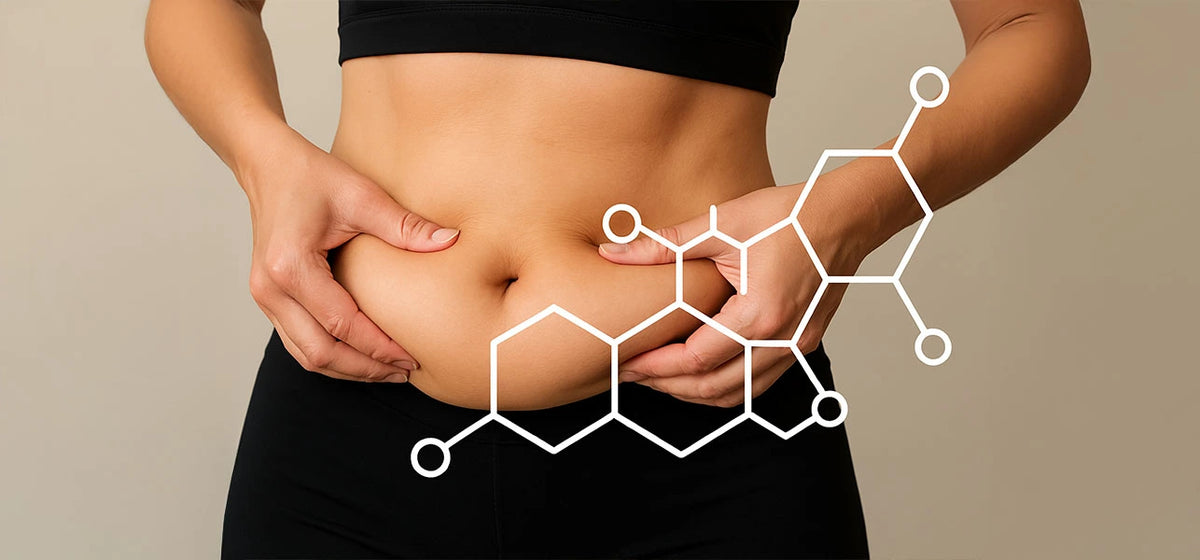
You've been told to eat less. But cortisol does one very specific thing: it pulls fat off your limbs and packs it around your organs. Deep. Around the middle. You can cut carbs for three months and watch it stay exactly where it is.
You've been told it's your age. It's a stress response that never switches off. Flat out by 9pm, wide awake by 3. That isn't tiredness — that's a hormone stuck in the on position.
You've been told it's willpower. It's blood sugar, driven by the same hormone. Cortisol spikes your glucose, your body answers with insulin, and by 4pm you'd fight someone for a biscuit.
You've been told it's hormones — said vaguely, as if that ends the conversation. It's the mechanism. The same stuck stress response that's breaking your sleep is flattening your patience.
You've been told it's normal. Broken sleep is where it shows first, because the deep part of sleep is when your brain clears itself out. Nobody treats it as anything more than annoying.
You've been told nothing's wrong, because nothing showed up on the test. Cortisol isn't on a standard panel. The one thing driving all of it never got looked at.
If you ticked three or more, that isn't a coincidence. It's one cause with seven faces.
Your body decides all day whether to burn fat or store it. That decision isn't made by calories. It's made by cortisol — the stress hormone.
When cortisol is low, you burn. When it's high, you store. And you store in one place: cortisol pulls fat off your limbs and packs it around your organs.
In your forties, cortisol stops coming down. Not because you did anything wrong — because your hormones are moving, and the stress response stops switching off the way it always has.
Magnesium is the raw material your nervous system uses to stand the stress response down. Like a fire can't go out without water, cortisol can't come down without it.
In your forties, between the hormones, the broken sleep and ordinary life, you burn through it faster than food replaces it.
Six in ten women over 40 are running low. Almost none of them know.
Which means you've been dieting for a problem that lives in your nervous system.
The cheapest and most common form on shelves is magnesium oxide — the kind in most drugstore capsules and supermarket gummies. Barely absorbed, and famous for stomach cramps and bloating. It never reaches the switch.
The form that does is magnesium glycinate — bonded to two glycine molecules, an amino acid with its own calming effect on the nervous system. It supports GABA, the signal that tells a racing mind to stand down.
Two gummies before bed. That's the whole routine — no new diet, no punishing workouts, nothing to white-knuckle.
Week one, the exhaustion starts lifting. Week three, the 3am wake-ups thin out. Week six, the 4pm cravings go quiet. Week ten, the belt goes in a notch.
Not because something was forced. Because the switch finally works and your body does what it already knew how to do.

Sugar-free, non-GMO, third-party tested. Free shipping and a money-back guarantee.
Results may vary.